Memorizing a shuffled deck of cards#
A few years back, I thought it would be fun to exercise my brain by learning to memorize the order of a randomly shuffled deck of cards. This article explains the technique so that anyone with an interest can join in the fun.
My custom mnemonic system for this purpose stands at the intersection Person-Action-Object-Environment (PAOE), and the Method of Loci (MoL), with a robust dash of Mnemonic Major (MM). (I’ll explain the Mnemonic Major aspect in another post.)
There’s nothing special about using these systems in particular, nor about combining them. What makes the system mine is the particular keywords I chose and the constraints I imposed on keyword selection and image formation. I’ll explain my rules and share my chosen words later in this post. But first, I’ll summarize the technique.
The technique in a nutshell#
- Prep work: PAOE: Permanently associate each card with a vivid, contrived scene in which a memorable person (such as a celebrity) performs some strange but visually distinct action on some direct object while standing in front of some tall or large background environment. For example, the eight of clubs might be Marilyn Monroe sweeping a feather boa over handcuffs in front of the Timberline Lodge, while the queen of spades might be Richard Farnsworth roping a saxophone in front of a saguaro.
- Prep work: MoL: Imagine a trip through your own home or workplace (or some other well known venue) that has thirteen waypoints. The important thing here is that the path of navigation must always be exactly the same and that the waypoints are unambiguous and unwavering. This permanent path makes that venue your Memory Palace.
- To Memorize the Order of the Shuffled Cards: Take the cards in batches of four. Imagine a scene using the Person from the first card, the Action from the second card, the Object from the third card, and the Environment from the fourth card. Mentally walk through your Memory Palace and place that unprecedented, bizarre, newly imagined scene at the first waypoint. The scene from the next batch of four cards belongs at the next waypoint, and so forth until all thirteen waypoints are filled with images constructed from all 52 cards taken in batches of four.
- To Recall Those Cards in Order: Mentally navigate through the memory palace again. At the first waypoint, recall the bizarre scene that resides there, decode it into its four contributing cards, and name them in PAOE order. Proceed to the next waypoint and do the same.
The technique explained in more detail:#
The Person-Action-Object-Environment (PAOE) system is a way to mentally generate vividly memorable scenes that consist of
- a visually distinct main actor
- doing something unusual
- to a noteworthy direct object
- in a remarkable setting.
For example, it would be quite surprising to happen upon Rick Steves chroming a dollhouse in front of corn stalks. Why would he do that? Who wants a shiny, reflective dollhouse? Is the chrome coming from a sprayer? Why corn stalks? Do they surround the dollhouse? And why isn’t Steve off wandering the walkways of Cinque Terre?
The scene is so odd and unexpected that it stands out in memory, and by integrating the four elements and animating the scene, human imagination can make that sort of combination even more memorable.
A note on memorable PAOE content: as Wikipedia helpfully points out, “Mental images may be easier to remember if they are insulting, violent, or obscene.” Since watching or reading political news already exhausts my mental capacity for negative imagery, an important goal for my mnemonic system is that it generate non-violent, non-sexual, non-insulting, non-provocative, inoffensive imagery that is nevertheless memorably surprising and odd. This is a family-friendly mnemonic system by design. So, for example, none of the transitive verbs is an act of destruction, and none of the objects of those verbs is an animal that might come to harm. We can hoist or juggle or spraypaint a cog, but we wouldn’t want to do any of that (nor anything worse) to a dog.
Here’s my selection of words. Below the table, I’ll explain the choices.
| Card | Person | Action | Object | Environment |
|---|---|---|---|---|
| ♠︎ A | Summer Glau | decanting | a settee | a crab statue |
| ♠︎ 2 | Taylor Swift | swinging | a sign | the Rotunda |
| ♠︎ 3 | Nicola Tesla | orbiting | a semi | the Bean |
| ♠︎ 4 | Rick Steves | test-tubing | a sari | Mount Rushmore |
| ♠︎ 5 | Denzel Washington | crowning | a sail | a guitar |
| ♠︎ 6 | David Letterman | phoneboothing | a sash | a barrel |
| ♠︎ 7 | Misty Copeland | spraypainting | a sack | cornstalks |
| ♠︎ 8 | Nick Nolte | barcoding | a safe | a rocket |
| ♠︎ 9 | Sandra Bullock | bedazzling | a sub | a voting booth |
| ♠︎ 10 | Mickey Rooney | padlocking | a seesaw | a tornado |
| ♠︎ J | Rob Lowe | bell-jarring | a satellite | Delicate Arch |
| ♠︎ Q | Richard Farnsworth | roping | a saxophone | a saguaro |
| ♠︎ K | Margaret Dumont | bubble-wrapping | a saddlebag | the Hollywood sign |
| ♦︎ A | Mandy Patinkin | photocopying | a date | a bison |
| ♦︎ 2 | David Bowie | rocking | a dune | a bicycle rack |
| ♦︎ 3 | David Niven | toasting | a dome | the Old Well |
| ♦︎ 4 | Rudolf Nureyev | chroming | a door | the Space Needle |
| ♦︎ 5 | Nathan Lane | clown-nosing | a doll | a Walmart |
| ♦︎ 6 | Scarlett Johansson | hoisting | a dish | a pilgrim |
| ♦︎ 7 | Steve Martin | mold-casting | a deck | a smokestack |
| ♦︎ 8 | Natalie Portman | kenneling | a duvet | a pool table |
| ♦︎ 9 | Leonard Nimoy | saluting | a doughboy | indigo crates |
| ♦︎ 10 | Rhea Perlman | hologramming | a dollhouse | a grizzly bear |
| ♦︎ J | Maya Angelou | aproning | a dental plate | Spoonbridge and Cherry |
| ♦︎ Q | Ricky Jay | clothes-pinning | a diving fin | a teepee |
| ♦︎ K | Anoushka Shankar | hugging | a diving mask | a mitten |
| ♣︎ K | Tina Fey | juggling | a candlestick | a Tabasco bottle |
| ♣︎ Q | Dominic Monaghan | armoring | a candycane | a red rooster |
| ♣︎ J | Michael Jackson | polygraphing | a coconut | a slot machine |
| ♣︎ 10 | Nancy Reagan | wagoning | a compass | the Gateway Arch |
| ♣︎ 9 | Robert Redford | weighing | a cob | Devil’s Tower |
| ♣︎ 8 | Marilyn Monroe | feather-boa-ing | a cuff | Timberline Lodge |
| ♣︎ 7 | Russell Crowe | sponging | a cake | a flying saucer |
| ♣︎ 6 | Leslie Stahl | inspecting | a cage | longboards |
| ♣︎ 5 | Maggie Smith | extinguishing | a coil | a cheese wedge |
| ♣︎ 4 | Salvador Dali | mustaching | a card | a highboy |
| ♣︎ 3 | Smokey Robinson | whipped-creaming | a comma | a peach |
| ♣︎ 2 | Nicole Kidman | green-sliming | a cone | an orange tree |
| ♣︎ A | Reba McEntire | butterfly-netting | a cot | a spud |
| ♥︎ K | Martin Landau | leaf-blowing | a hockey puck | a mineshaft |
| ♥︎ Q | Doris Day | winding | a hunting horn | the Statue of Liberty |
| ♥︎ J | Neil Simon | wallpapering | a honeypot | a riverboat wheel |
| ♥︎ 10 | Morgan Freeman | forklifting | an hourglass | skis |
| ♥︎ 9 | David Copperfield | levitating | a hoop | the Goodyear Blimp |
| ♥︎ 8 | Diana Ross | camcording | a hi-fi | a tapped maple |
| ♥︎ 7 | Rodney Dangerfield | marionetting | a hook | a cabin |
| ♥︎ 6 | Ian McKellan | twirling | a hedge | a lighthouse |
| ♥︎ 5 | Sally Field | spinning | a heli | a palmetto |
| ♥︎ 4 | Stan Laurel | piggybacking | a harrow | Harkness Tower |
| ♥︎ 3 | Nathan Fillion | plinthing | a ham | a derrick |
| ♥︎ 2 | Stevie Nicks | leapfrogging | a hone | the Liberty Bell |
| ♥︎ A | Liv Tyler | venerating | a hat | an obelisk |
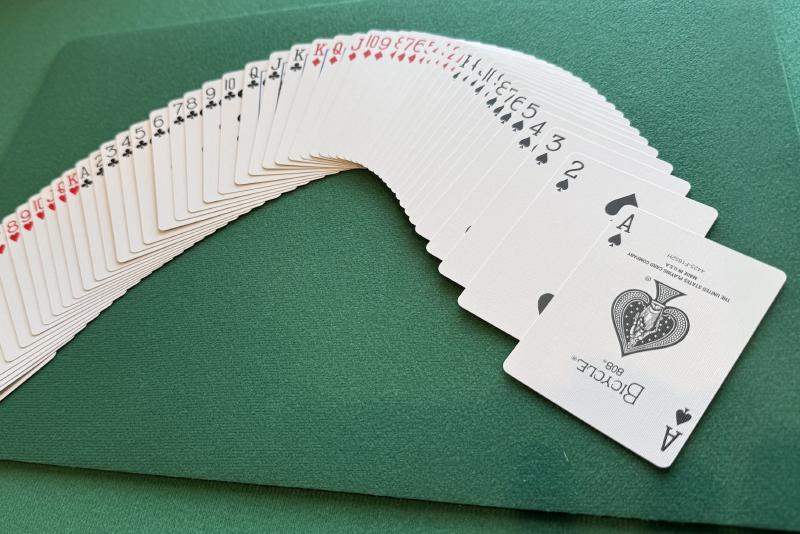
The cards are listed here in US New Deck Order, the face-up order in which you’ll find them if you pop open a deck of Bicycle playing cards.
Once we have learned to associate these given scenes with these cards, it’s easy to interpret that scene of Rick Steves chroming a dollhouse in front of corn stalks. It decodes to 4 of spades, 4 of diamonds, 10 of diamonds, 7 of spades.
Notes on my customization#
Notes on the Persons#
Each person has a two-word name, first and last but no middle name and no additional factors (such as a title or suffix). I’ll explain more about that in another post.
The key requirements, relative to the learner/memorizer, are
- that each person be very familiar, and
- that each person be visually distinct and easily recognized
So, for example, a particular novelist might be quite famous and known to me because I read novels, but I might not know how that author looks; such a person, though famous, would be excluded from this list. In contrast, I don’t know much about Stan Laurel, and I’m not a fan of Laurel and Hardy movies, but Stan Laurel’s appearance is visually distinct and I know it well from the common culture, so he’s included.
There are some categories of people I do not know well. I don’t follow team sports and know only a few individual athletes, so I have excluded sports figures. I’m fed up with politicians, so I have excluded elected leaders, despots, royals, usurpers, and anyone else who is chiefly known for holding public office.
Notes on the Actions#
English has a good number of transitive verbs, but it’s surprising how many of them are either abstract or violent. In a context where I prefer concrete, non-violent verbs and need fifty-two of them that sound ok in the present progressive, that’s a real impediment. I used up my supply of vivid, naturally occurring verbs that take direct objects, including such actions as hugging, saluting, swinging, camcording, and polygraphing. Then I included some with specialized or contrived meanings:
- “decanting” means, surreally, pouring the object out of a normal decanter as liquid that then takes the proper shape of the object.
- “orbiting” is flying through the air around something
- “test-tubing” means somehow, surreally, putting the object into a giant test-tube.
- “phoneboothing” is cramming something into a phone booth
- “bell-jarring” means placing a bell jar over something
- “roping” is throwing a lasso over something
- “rocking” is the gesture of moving a cradle back and forth
- “toasting” doesn’t involve heating elements; it’s raising a glass of champagne to something
- “clown-nosing” is putting a red foam clown nose on something
- “mold-casting” involves impressing the object into plaster of Paris.
- “hologramming” is projecting a hologram of something
- “armoring” is putting armor on something
- “wagoning” is pulling something around in a little red wagon
- “weighing”, in my imagination, entails using a libra scale with counterweights
- “feather-boaing”, a contrived verb too visual to forgo, is dragging a feather boa over the surface of something
- “inspecting” is looking at something through a large magnifying glass
- “extinguishing” means spraying a fire extinguisher at something
- “mustaching” is putting a false mustache on something
- “winding” is turning the sort of key that appears on a toy to wind something up
- “twirling” is an overhead action similar to the use of a baton
- “plinthing” is just mounting an object onto a plinth for display
I included no verbs that have mandatory prepositions. So “turning back” and “winding up” and “casting aside” and “looking over” were not eligible.
Some of these contrivances seem physically impossible or surreal, but that’s not a disadvantage. It’s a virtue when the whole point is to make memorably bizarre scenes.
Notes on the Objects#
- Aces through nines have one or two syllables.
- Tens have exactly two syllables with a tonic stress on the first syllable (trochees): seesaw, compass, dollhouse, hourglass.
- Court cards have exactly three syllables with the first syllable stressed (dactyls).
- Jacks always end in a ’t’ sound: satellite, dental plate, coconut, honeypot
- Queens always end in a ’n’ sound: saxophone, diving fin, candy cane, hunting horn
- Kings always end in a ‘g’/‘k’ sound: saddlebag, diving mask, candlestick, hockey puck
- The first sound of every object gives the suit: spades all start with ’s’ (“settee”, “sign”, “semi”, “sari”), diamonds with ’d’ (“date”, “dune”, “dome”, “door”), and so forth.
- (optional) Aces through nines always have exactly two consonantal sounds: the first gives the suit, as mentioned, but the second gives the card’s value in Mnemonic Major (not necessary for this memorization technique, but helpful). So “sign” isn’t just a spade; it’s the two of spades. And “door” isn’t just a diamond; it’s the four of diamonds.
Some of the objects are unusual because of the constraints on syllable count and consonant sounds. Here is how I prefer to think of the strange or ambiguous ones:
- “sign” is a traffic sign, not an arcane sigil
- “semi” is an eighteen-wheeled long-haul truck
- “sash” is not a belt; it’s the common two-part window that slides up and down in tracks within a frame
- “sub” is a submarine, not a sandwich
- “date” is a fruit, not a calendar entry
- “dune” is a pile of sand
- “dish” is a large piece of ceramic kitchenware
- “deck” is a deck of cards, not an elevated patio
- “duvet” is a comforter
- “doughboy” is the Pillsbury mascot guy, not a WWI infantryman
- “dental plate” is a denture
- “diving fin” is flat, floppy footwear
- “cuff” is a handcuff, not a sleeve cuff
- “coil” is just a big metal coil
- “comma”, surreally, is a huge, 3d punctuation mark
- “cone” is an orange traffic cone
- “honey pot” is a huge vat of honey rather than an alluring avatar of espionage or a sneaky network segment simulator
- “hedge” is just a lengthy segment of shrubbery
- “heli” is a helicopter
- “harrow” is like a pocket comb, except that it’s huge and tractors drag it over fields
- “hone” is a metal block used for sharpening blades
Notes on the Environments#
Each environment symbolizes one of the fifty US states, plus Washington DC (obelisk) and Puerto Rico (indigo crates). So, the Statue of Liberty means New York, and corn stalks mean Nebraska, and so forth. It’s not necessary to know this, but knowing it might help with memorization of the permanent PAOE scenes.
Working through an example#
Suppose we have randomly shuffled a deck and are now holding it face down. Turning over the top four cards, we see:
Five of Diamonds
Jack of Hearts
Eight of Clubs
Queen of Clubs
The person corresponding to Five of Diamonds is Nathan Lane. The action corresponding to Jack of Hearts is wallpapering The object corresponding to Eight of Clubs is a cuff. The environment corresponding to Queen of Clubs is a red rooster.
So we start to enter our memory palace. But right there, on the porch, stands Nathan Lane, and he’s using a dripping, stick-borne roller to apply a roll of wallpaper to a giant metallic handcuff that someone has inexplicably placed on the two legs of an enormous, storey-high red rooster.
I’m not sure why this is happening on my porch, but I move on, entering the foyer. We turn over the next four cards:
Two of Hearts
Five of Spades
Ten of Clubs
Six of Clubs
It seems that in my foyer, Stevie Nicks is crowning a compass before a row of longboards. The surfboards reach all the way up to the ceiling, and the compass is firmly affixed to, and sticking out horizontally from, the longboard in the center, which is red, just like the red point of the compass needle. The compass is pointing right at Steve, who holds aloft a very regal crown that she gradually lowers onto the compass. Perfect fit!
My living room is through a doorway to the left. I enter and draw cards:
Three of Spades
Two of Diamonds
Eight of Diamonds
King of Diamonds
To my astonishment and delight, Nicola Tesla is rocking a cradle. What’s in the cradle? It’s filled with a fluffy, folded duvet. Digging down into the covers, I find a diving mask. Looking up at Nicola, I see that he’s also wearing a diving mask.
…
If I wished to recall these twelve cards in the given order, I’d start again on my front walkway, recall the scene on the porch, navigate into the foyer for the second scene, turn through the doorway into the living room for the third scene, and so on. Only ten more to go!
That’s how I choose to memorize randomly shuffled decks of cards. In a subsequent post, I’ll explain how this exact technique, combined with some Mnemonic Major cues that are already baked into the words, can help us to memorize a randomly generated 100-digit number.