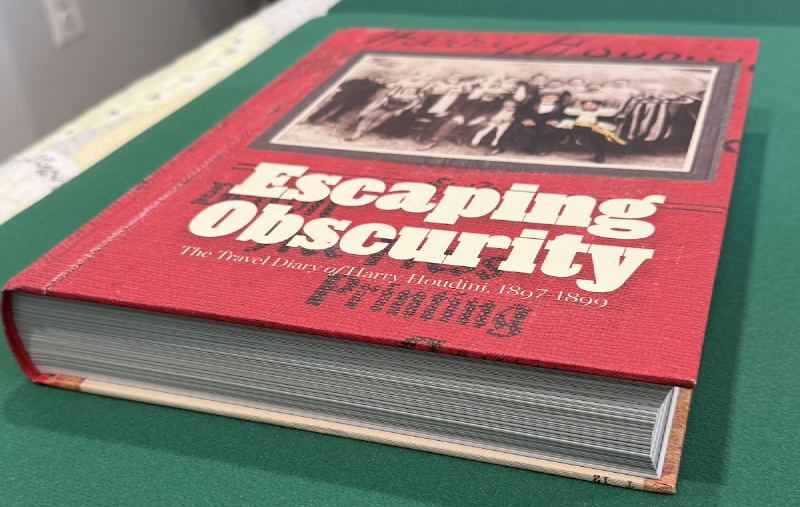
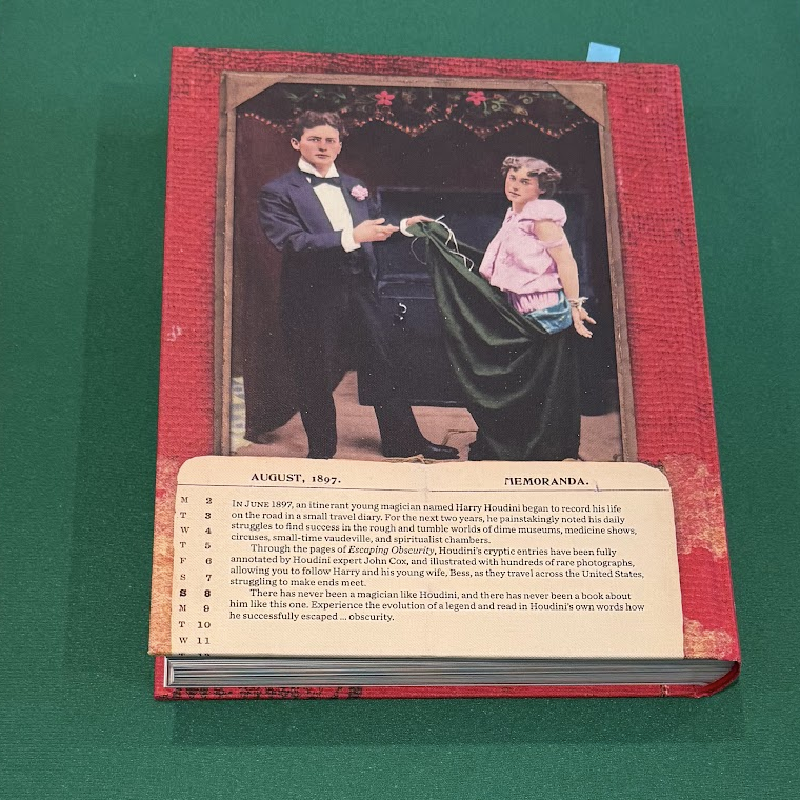
What: John Cox, Escaping Obscurity: The Travel Diary of Harry Houdini, 1897-1899
(Pasadena, CA: Mike Caveney’s Magic Words, 2025)
Where Available: https://www.magicwords.shop/all-books/p/escaping-obscurity-regular-edition
This book is full of truths.
Escaping Obscurity covers a period in the career of Ehrich Weiss when there were no myths, no legends, and no exaggerations about Houdini. No lore had accumulated and grown glamorous in the retelling, because the performer was still finding his way. That’s what makes this annotated record special: during the 1897-1899 seasons, Harry and Bess were working hard as the Houdinis, but they did not yet know—they hoped, they dreamed, they strove, but they did not know—that he would soon become stupendously famous and successful.
Ehrich Weiss did not keep this travel diary because he was already important, a person whose deeds merited chronicling, someone whose salad days should be documented for posterity and biographers. No, it’s just that printers like The Detroit Free Press routinely manufactured and sold these double-season showbiz diaries, and Houdini bought one and used it to track his bookings because that’s just what itinerant entertainers did, and he wanted to be a pro. Besides, promos from the printer itself insisted that such a date book was “indispensable to theatrical folk.” Precisely because it’s completely free of pretense and hype, this diary offers a vivid, uncontrived look at the genuine daily grind of the Not-Yet-Great Houdini.
The diary is, as expected, mostly a list of dates and places—not exactly the compelling reading that one seeks in a biographical treatment. Its interest lies in the annotator John Cox’s extracurricular remarks that give the chronology life and flavor and in the places where he adds value by placing minor moments from this part of Houdini’s life into their broader social and cultural contexts. For example, mentions of Coney Island or Huber’s Dime Museum prompt Cox to share illustrations from the Library of Congress, the Ransom Center, the Copperfield Collection—from all the usual suspects, but not the usual pictures—as well as to harvest content from contemporary newspapers and to quote scholarly commentary on the Dime Museum phenomenon. When Houdini mentions another act, Cox tracks it down. Where he mentions hot sales or lagging attendance, Cox tries to figure out why.
One vacation day, Houdini notes that he “rode a wheel of 120 gear everyday ran away from all bike cops”—and so Cox diligently follows up with known connections between Weiss and bicycles and with a bit of background about how penny-farthings gave way to bikes with a more favorable gear ratio. Because he knows the literature, Cox not only associates the mention of a rainy arrival in Lancaster, PA, with an anecdote about the early years recounted in Houdini: His Life Story but also gently corrects Bess’s recollection. To read Escaping Obscurity attentively is to join the Houdinis on the road as they hawk goods on the side for extra cash, witness and risk trapeze accidents, and meet with a fascinating array of fellow travelers trying to learn what works, what plays, what detracts, and what’s a draw as they all look for their respective big breaks. And, of course, we even see the moment when Houdini gets his.
One more thing worth mentioning: Escaping Obscurity is not a vanity project in which some trivial document is made to seem more important than it is by padding its presentation with secondary material. Instead, Escaping Obscurity is an act of reverence, a recognition of how astonishing it is that this document from the early career of Houdini has survived. Escaping Obscurity is also a passionate attempt to share the diary’s contents fully and fruitfully. It is a sincere and successful attempt to do justice to the rarity, authenticity, and importance of this single, remarkable document. And it is an enlightened demonstration of how to make privately held artifacts reasonably available to anyone interested, and to do so in the best, most enjoyable, most useful way possible. Bruce Averbook, owner of the travel diary, and the cohort of contributors responsible for this publication, deserve great respect for their approach to this sharing and to the high quality of the book’s manufacture. Escaping Obscurity is an excellent product, a rich and beautiful book, and a landmark in Houdini studies.